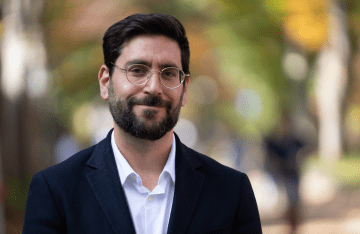
Sarah J. Jackson Elected President of the International Communication Association
Jackson will lead the professional association of more than 5,000 communication researchers across more than 80 countries.

Sarah J. Jackson, Associate Professor of Communication at the Annenberg School for Communication, was elected president of the International Communication Association (ICA), the major professional association for communication researchers worldwide.
She will serve as president-elect beginning on June 7, 2027 — the last day of the association’s annual conference in Glasgow, Scotland — and will move into the position of president a year later.
“I am deeply honored by the trust that my colleagues, students, and mentors across the field of communication have placed in me through this election,” Jackson said. “I am thrilled by the opportunity to serve the International Communication Association and the remarkable community of scholars who make it a vital intellectual home.”
Jackson, co-director of the Media, Inequality & Change Center at Annenberg, studies how media, journalism, and technology are used by and represent marginalized publics, with a focus on how communication arising from Black, feminist, and activist spaces contributes to U.S progress. Her groundbreaking research includes investigations into how marginalized groups use social media to advance counter-narratives through hashtags like #BlackLivesMatter and #MeToo; political dissent by Black celebrities in the Black and mainstream press; and how television news shapes collective memory of Black activism.
Her new book, “A Second Sight: How the Wonder and Vision of Black Mediamakers Push America Toward Freedom,” traces how Black journalists, photographers, filmmakers, radio hosts, podcasters, and other mediamakers have, throughout history, advanced democracy and broadened our most fundamental American values.
“I am thrilled that Sarah has been elected ICA President,” said Sarah Banet-Weiser, Dean of the Annenberg School. “The honor is a well-deserved recognition of her standing as a leading scholar of race, media, and social justice. Sarah is also a generous colleague and mentor, deeply committed to supporting our students, especially our students of color, advising junior scholars, and teaching courses on relevant and urgent issues. Annenberg is immensely proud, and we know she will lead the association with vision and care.”
An Andrew Carnegie Fellow, Jackson has earned awards and fellowships from the Institute for Advanced Study in Princeton, the Harvard Shorenstein Center for Media, Politics and Public Policy, and New America, among others. She is also the co-author of "#HashtagActivism: Networks of Race and Gender Justice" and "Black Celebrity, Racial Politics, and the Press." Her research has been published in the Journal of Communication, Feminist Media Studies, Information, Communication & Society, Media, Culture & Society, and New Media & Society, among others. She is regularly called on as an expert by local and national media outlets, including NPR, PBS, NBC News, The Philadelphia Inquirer, The Boston Globe, and The New York Times.
Jackson shared heartfelt appreciation for her fellow presidential candidate, Penn State Professor Christopher Ali (Ph.D. ‘13). “I want to express my deep admiration for my friend, Christopher Ali,” she said. “It was an honor to run alongside such an outstanding scholar and representative of the field.”
ICA is an international association with more than 5,000 members in over 80 countries and advances the scholarly study of communication by encouraging and facilitating excellence in academic research worldwide. Since 2003, ICA has been officially associated with the United Nations as a non-governmental organization (NGO).
Reflecting on her new role, Jackson said: “I accept this responsibility with clear eyes. We are living through a moment of profound challenges for higher education, democratic institutions, and our media and information ecosystems. Yet it is precisely in moments like these that communication scholarship is most urgent. Our research, teaching, and public engagement have an essential role to play in helping societies understand and address the complex issues before us.”