

Exploring Feminist Unity Through Art, Academia and Activism
A recent symposium and art exhibit at Annenberg examined the growth, maintenance, and challenges of feminist solidarities in our interconnected world.
In the last decade, a media-friendly, flashy “popular feminism” has gained traction — spread through hashtags, advertisements, television shows, and even global superstar Beyoncé’s single “***Flawless,” which sampled Nigerian author Chimamanda Ngozi Adichie’s TEDx Talk, “We should all be feminists.”
Though popular feminism has introduced a new generation to feminist theory, it can often overshadow the everyday work of feminist groups that work both online and offline to fight gender-based discrimination and violence, far-right populism, and systemic attacks on the rights and bodily autonomy of women and gender-diverse individuals around the world.
In September 2024, scholars, artists and activists gathered at the Annenberg School to explore how feminist groups communicate, create culture, critique and imagine new forms of transnational feminist solidarity and connection. The two-day Transnational Feminist Networks Symposium was organized by a collective of Annenberg doctoral students — Cienna Davis, Sim Gill, Valentina Proust, and Lucila Rozas — and supported by the Annenberg Center for Collaborative Communication, the Center for Advanced Research in Global Communication, and the Center on Digital Culture and Society.
The conference featured a keynote address by Srila Roy of the University of the Witwatersrand in Johannesburg; a conversation with artist Sonia E. Barrett; three panels exploring the past, present and futures of transnational feminist networks; and “Present Futures: Experiments in Feminist Futurity,” an art exhibit organized by the students, which featured art by Davis, Gill, Rozas and recent graduate Azsaneé Truss, among other artists. Panels included discussions of transnational feminist networks in Bangladesh’s Red July, digital feminist activism in Spain, the popularity of the Korean 4B movement on English-language TikTok, and more.
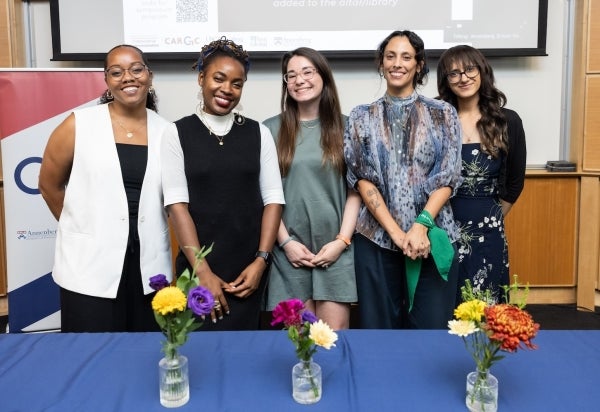
It was important to the student organizers to include the voices of those outside the academy in the symposium. Organizing an art exhibit was one way to do that. “As five scholars who embody feminist principles in both our research and personal lives, curating this exhibit provided a unique opportunity to foreground art as a powerful medium for dialogue and a site for reimagining belonging within academic spaces,” said Gill. Rozas felt the same: “We recognized the importance of giving proper space to forms of knowledge transmission that are rarely considered authoritative in academia, especially knowledge from outside of the U.S. and other hegemonic settings.”
To stage the exhibit, students had to choose from over 60 submissions from feminist artists, ultimately selecting 10 artists to spotlight. “Part of the challenge was selecting pieces that, together, would not only complement each other aesthetically but also create a cohesive narrative around the theme, telling a story,” Proust said.
Truss, Davis, Rozas, and Gill contributed their own artwork to the exhibit, and attendees also participated by adding to a collaborative collage that evolved over two days.
Associate Professor Sarah Jackson moderated panel two of the symposium — “Connections: Media, Technology, and Transnational Feminist Networking” — and was impressed by the students’ work.
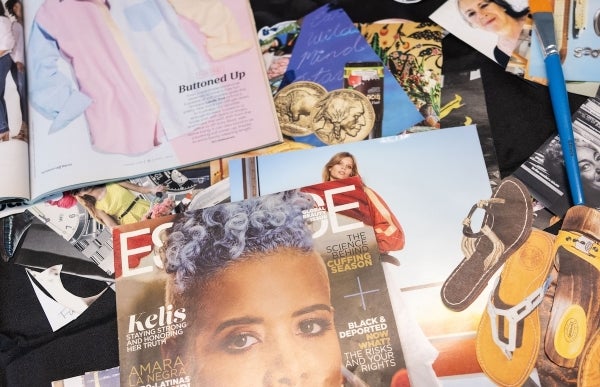
“Working with the graduate student organizers of the Transnational Feminist Symposium was truly impressive. Their thoughtful decision to pair scholarly discussion and debate with an art exhibit exemplified the power of multimodal engagement,” she said. “The exhibit not only deepened the symposium’s intellectual, emotional, and aesthetic impact, but also opened space for community-building and public outreach.”
Putting together the exhibit and symposium was not an easy feat, but Rozas believes their effort was worth it. “For me, one of the most important things about the exhibition is that it showcases, in different ways, different visions of what enacting the present in the future means and how there are connecting threads in the forms we think about it, which is what, ultimately, allows a feminist transnational project to flourish,” she said.
Davis hopes to see more multimodal symposia at Annenberg. “I hope the exhibition encourages other grad students to consider the benefit of their artistic practices to their scholarship and to know there is space for this kind of work to be received at Annenberg,” she said.
“I think art can encourage deeper engagements with the topics that are being discussed at a symposium. During a traditional symposium, you listen, take notes and perhaps ask questions, but the exhibition offers a space and time for contemplation and reflection that a talk cannot provide. It invites the participants to engage with the messages using all their senses, offering a more embodied experience,” said Proust.
