

Intersections of Inquiry: Annenberg Postdocs Explore Ideas Across Disciplines
Early-career scholars at Annenberg find inspiration in the intersections between their research, from the working conditions of journalists to the environmental costs of urban development.
At the Annenberg School for Communication, postdoctoral fellows are at the heart of the school’s intellectual ecosystem.
Despite being the smallest school at the University of Pennsylvania, Annenberg hosts around two dozen postdoctoral fellows every year. These early-career scholars not only advance groundbreaking research but also forge connections across the school’s many centers and labs, shaping the future of communication scholarship in the process.
Walk down the halls of Annenberg, and you might overhear a conversation breaking down the neuroscience behind climate change action, or a debate about political polarization and its effects on democratic institutions. You might hear someone analyze how ideas of feminism show up in TikTok videos or how contemporary film portrays national borders. Many of these discussions are led by the School’s vibrant community of postdoctoral fellows, and often their conversations lead to unexpected connections.
In the spring, eight of these postdocs brought their research to ignite these kinds of cross-disciplinary conversations at a colloquium co-hosted by five different centers at the School: the Center for Advanced Research in Global Communication, the Annenberg Center for Collaborative Communication, the Center for Media at Risk, the Center on Digital Culture and Society, and the Media, Inequality & Change Center.
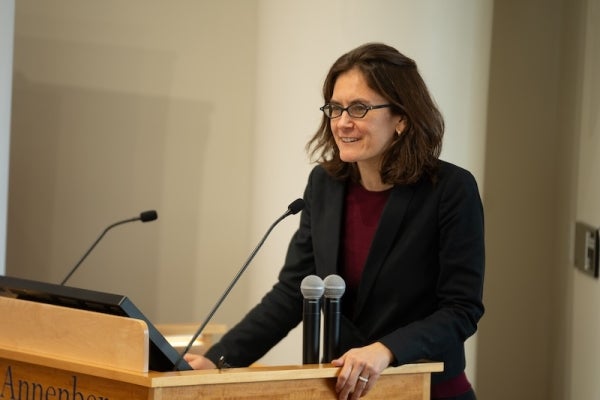
Opening the event, Vice Dean Emily Falk praised the work that these early-career scholars do — from their time in the classroom, teaching and mentoring students, to their pursuit of research that expands the field of communication.
“This colloquium is a celebration of the curiosity and depth and creativity that define scholarship at Annenberg,” she said. “The conversations that begin here today have the potential to shape new ideas, new collaborations and new directions of research here at Annenberg — and to define the field.”
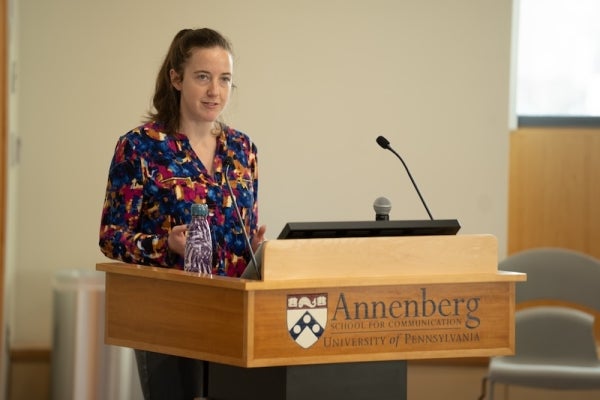
After watching a presentation by George Gerbner Postdoctoral Fellow Cerianne Robertson, a researcher who examines the social costs of urban development, Jeanna Sybert (Ph.D. ’24), a postdoctoral fellow at the Center for Media at Risk, said she will think about her own research differently.
Robertson spoke about her work exploring the human and environmental costs of mega-arenas — drawing from her interviews with members of communities facing displacement when these stadiums are slated to be built in their neighborhoods. Sybert shared her research on the working conditions of journalists, a topic she’s been investigating since she first arrived at Annenberg as a student. Her recent work examines the risks journalists face on the job, from reporting outside during hurricanes to attending protests, and how these risks shape news work as a whole.
“My research typically centers events — analyzing the sensemaking and discourses around them — rather than specific places and physical structures, so what caught my attention was how Cerianne started from a single material point (the stadium) and traced the network of sites, stakeholders and relationships that both emerge from and constitute this central node,” she said. “Seeing Cerianne’s approach made me realize we’re both looking at layers of connection, just with a different orientation and emphasis … [A]s I’ve been thinking more about mobility in journalism lately, this approach could enhance my understanding of the physical spaces where news ‘happens’ going forward.”
Alyssa Sinclair, Joan Bossert Postdoctoral Fellow at the Annenberg Public Policy Center and the Penn Center for Science, Sustainability, and the Media, didn’t present at the colloquium, but says that interacting with other postdocs at Annenberg has enriched her research. Annenberg, the postdoctoral program insists that research is richer when pursued in community.
“Postdoctoral fellows at Annenberg are doing research at the cutting edge of our field,” he said. “And in a moment marked by deep cynicism about research and higher education, a colloquium like this is a vital affirmation of the importance of coming together to share ideas and insist that the work we do matters.”
This intellectual network doesn’t thrive by chance. Each week, postdoctoral fellows come together in a writing group led by Eszter Zimanyi, research director at the Center for Advanced Research in Global Communication. Zimanyi’s group offers dedicated time for writing, peer feedback, and informal mentoring — creating a supportive space that sustains the fellows’ momentum and fosters collaboration across projects and centers.
“I am a cognitive neuroscientist by training, and before coming to Annenberg, I had never interacted with a community of communication scholars,” she said. “I love that others at the school share my passion for applied research that helps to address some of the biggest societal challenges we are facing today. Being a postdoc here has introduced me to people who share my research interests but apply different methods and theoretical perspectives. I’ve heard from other researchers that the postdoc period can be quite lonely, as postdocs move to new places for transient positions and often have few peers. Thankfully, I did not experience this at Annenberg.”
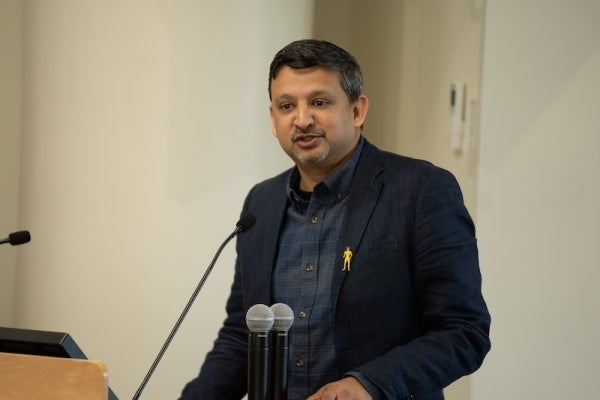
Since its founding in 2013, the Center for Advanced Research in Global Communication has hosted over 20 postdocs from around the world. Director Aswin Punathambekar emphasized how essential these scholars are to sustaining a vibrant academic community: He said that academic research can sometimes be solitary, yet at across centers, disciplines, and methodologies, Annenberg’s postdoctoral fellows are shaping what communication means in the twenty-first century. Their work — rigorous, creative, and deeply engaged with the world — reflects the School’s commitment to research that not only studies communication but transforms it.
