

Introducing the Penn Center on Media, Technology, and Democracy
The Center brings together six schools at Penn with $10 million in support from the Knight Foundation and the University.
In September 2024, Penn announced the creation of the new Center for Media, Technology, and Democracy. The Center was conceived to propel research involving media, technology and democracy within Penn and to become a global hub for researchers, private sector leaders and policymakers by sharing research findings and creating near-real-time dashboards that provide a clear view of the current media landscape, informed by empirical research.
Professors Duncan Watts and Christopher S. Yoo (shown below) are co-principal investigators for the Center.
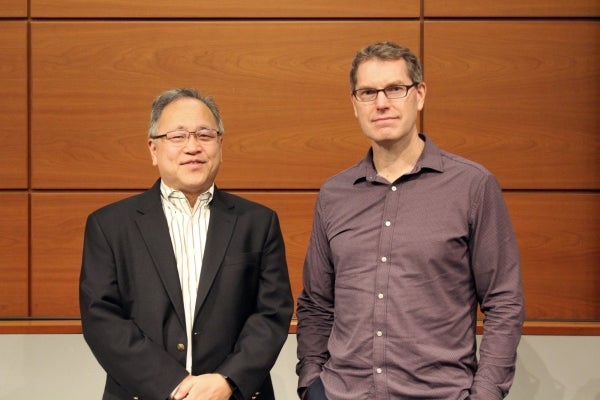
Watts, founding director of Penn’s Computational Social Science Lab, is an empirical scholar whose research is marked by innovation. He is the Stevens University Professor and a Penn Integrates Knowledge Professor with appointments in Penn Engineering, Annenberg, and Wharton. Yoo, the Imasogie Professor in Law and Technology at Penn Carey Law, with a secondary appointment at Annenberg, is the founding director of the Center for Technology, Innovation, and Competition at Penn Carey Law.
“The United States and other countries around the world are living through a series of crises associated with a high level of affective polarization and diminishing trust in institutions. Increasingly, we are finding ourselves in different universes in terms of what we understand about the world,” said Watts. “But public discourse is limited to simplistic explanations of what’s happening. Social media has a lot of data, but it is hard to get. Our approach will utilize a combination of AI methods applied to large data sets and behavioral experiments to uncover the prevalence, causes and consequences of misinformation and bias.”
In May 2025, Alex Engler joined the Center as executive director. Engler comes to Penn after serving as Director for Technology and Democracy on the United States National Security Council and as a Fellow in Governance Studies at The Brookings Institution.
“The Penn Center for Media, Technology, and Democracy works to advance our collective understanding of the information landscape through cutting-edge science — and leverage that research to foster a more informed society and strengthen the foundations of democracy,” Engler said. “Over the next year, the Center will launch a fellowship program and award grants for empirical research of the information ecosystem, and host a public event series and its inaugural flagship conference.”
The Center will benefit from a five-year, $5 million investment from the John S. and James L. Knight Foundation, with additional support from the Annenberg School for Communication and the Annenberg Public Policy Center, as well as Penn Engineering, Penn Arts & Sciences, the Wharton School, Penn Carey Law, and the School of Social Policy & Practice.
“Annenberg and Annenberg Public Policy Center’s leadership and commitment to researching the impact of AI and other emerging technology on society and democracy are essential as we delve into these important topics as a community and develop programs and opportunities for our students, faculty and the community at large,” said Sarah Banet-Weiser, Walter H. Annenberg Dean.
